Pages

Showing posts with label Parable. Show all posts

Sunday, 15 January 2012

Why believe in God?

"There is a hole in the ground, a dark cavernous recess with gaping aperture. There is a group of people that all wish to get to a point on the other side of the hole. Amongst these people is one who refuses to believe that the hole exists, he looks in the direction of the hole and says that the darkness is just shadows, that it’s all an optical illusion, a trick. Whilst everyone else is making their way carefully around the edge of the gaping abyss, this person strides out – unaware of the dangers, in the most direct route to the place he wants to be.

He falls, screaming, in to that dark maw. Realising, only too late, that the people around him weren’t deluded in their belief that the hole existed. There was a good reason why they didn’t just stride out as he had."


What meaning do you find in this parable? The main point that I’d like to highlight is that the man’s belief – or lack thereof – in the existence of the hole did not effect whether the hole actually existed. What peril did the man put himself in by believing wrong!

When someone asks; why believe in God? It is worth highlighting that whether you believe in him or not doesn’t effect his existence. If your belief is wrong, it is wrong and if it is right, it is right. To refuse to see any evidence that is presented is simply gambling – striding out like the man in our story.

But if you had to gamble? If you were blind and alone and couldn’t see the hole? What would be the best choice to make; believing that the hole existed or that it didn’t? This is known as Pascal’s wager. It precedes something like:

If you believe in God – and are correct, then you have gained everything promised (you get to the other side of the hole).
If you believe in God – and are wrong, then you neither lose nor gain anything (you still get to the other side of the supposed hole).
If you don’t believe in God – and are correct, then you neither lose nor gain anything (you get to the other side if the supposed hole).
If you don’t believe in God – and are wrong, then you lose everything (you fall into the hole).

The only way to lose out is to gamble that God doesn’t exist. Gambling that God does exist means you can’t lose. I hope this is an encouragement to investigate the existence of God further and not just consign it to the rubbish bin of ideas without a second thought.

Saturday, 22 January 2011

Then the Fire Came: an Image


Houses stand side by side: each one different, each built by a different hand, the hand of their owner. Some are tall towering eloquent edifices of architecture whist others are mere hovels. Some are made of humble material; of brick, of wood, of thatch and stone. Whilst others are structures of opulence; made from glass, precious metals, from gems and marble. They do not stand apart from each other but rather sit cheek by jowl as if each one were placed at random with no thought for the overall aesthetics of the neighbourhood.

The houses only had one thing in common, and that was the rock that they were built on. A hard bedrock, strong and solid but with many holes in. In fact each house was situated over such a hole, a cellar if you wish, or a place to hide if disaster struck. When disaster did stick it was in the form of a fire. A sea of flames spread across the city, jumping from one house to the next and fully engulfing each and every one. Not a single dwelling was sparred the judgement of the flames, from the smallest to the biggest the flames attacked each one with vigour and gusto.

Eventually the flames died down and were extinguished, and the people started to emerge from the bedrock in which they had hidden. Some came out to find that their house had only been singed whilst others emerged to still smoking debris, their entire house burnt to the ground. There was no pattern to which houses were still standing and which weren’t. In one place a hovel remained and all around the once tall towers had been raised to the ground. Whilst in other places this image was reversed.

In all of this there was only one saving grace: Each and every citizen of this metropolis had survived, each had been spared the force of the fire by the bedrock they sheltered in, a shelter that no hand had made.


1 Cor 3:11-15
“For no one can lay any foundation other than the one already laid, which is Jesus Christ. If anyone builds on this foundation using gold, silver, costly stones, wood, hay or straw, their work will be shown for what it is, because the Day will bring it to light. It will be revealed with fire, and the fire will test the quality of each person’s work. If what has been built survives, the builder will receive a reward. If it is burned up, the builder will suffer loss but yet will be saved—even though only as one escaping through the flames.”

Friday, 3 September 2010

How long should we wait for a miracle?


Yesterday, I was reading the comments on a post about abortion by Phil, an interesting question was raised about when is it too late for God to preform a miracle? Should we keep on waiting and hoping for God to intervene or try and sort out the situation ourself?

As I was thinking about this, an image came to mind which I shall now recount in the form of a Parable.

A Parable of the chasm and a bridge:

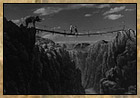
An army advances across a broken and cracked land, from horizon to horizon they stretch, slowly marching forward. Ahead of the army run three men of God, each focused on the surrounding ground, stumbling but not falling. They do not see where they are running, they do not see what is ahead of them only what is close around. Before them awaits a massive chasm, reaching far down into the earth, so deep that the bottom cannot be seen but is shrouded in darkness. Across the chasm hangs a rope bridge, swinging, unsteady and dilapidated. It is the only crossing along the entire length of the mighty chasm.

The foremost of the men stumbles to a stop at the edge of the Chasm, the bridge right in front of him; a bridge made by man. Not trusting in man but rather having great faith, and deciding that if it's God's will that he should pass the chasm then he will, the man takes a few steps back and starts running straight towards the chasm and jumps off trusting that God will catch him. God does not catch him this time, but rather, the man falls to his death.

Shortly afterwards the second man, by chance, arrives at the same point. He too is faced with the same dilemma, to use the rickety man made bridge or trust in God. Having glanced up as he was running he has seen what has just occurred to the first man. So as he comes to the edge of the chasm he pauses briefly and then calmly walks of the edge of the cliff. Reasoning that the only reason the first man wasn't saved was because his faith wasn't strong enough and that as his own faith was strong he would be fine. He too plummeted to his death.

A while later the third man stumbles upon the same point oblivious to what has happen already. He looks at the bridge and he looks at the chasm. The man made bridge is fragile and does not look like it'll bear his weight but it is a path across the chasm. Slowly, haltingly, the man steps out on to the bridge and walks across, trusting that if he falls God will catch him. This man does not fall but, rather, safely navigates the chasm, upon reaching the other side he starts running again to keep ahead of the ever advancing army.

The meaning?

Which of these men was wisest? Was it the first who trusted in God to save him or the second who trusted in his faith or was it the third who realised God's providence in placing the bridge where it was needed?

As well as a parable this may also be an allegory, with the Army symbolising time, the Chasm, death and the bridge being medicine, although I'm not entirely sure about that. I'd appreciate any comments as it would be good to know what people think.